Precision at Scale
Technical developments, paired with data-driven insights, drive targeted systems that save the firm time, money, and quality.
virtual machines managed.
of senior capacity returned.
users with automated Revit coaching.

For Parkhill, a multidisciplinary firm with more than 600 employees across 14 offices, digital management is not just about oversight. It is about governance. Operating at that scale requires a granular, real-time understanding of how people, projects, and technology work together.
After three years with Bimbeats, Shane Danley, VP of Design Technology, gave Software Engineer Marcelo Romero a clear mandate: use the platform's open data architecture to “build something cool.”
What emerged was a set of targeted solutions that reshaped how the firm manages infrastructure, reclaims management time, and reinforces best practices, using tools they already had.
Managing Capacity Requires Real-Time Visibility
When a growing firm operates under hard infrastructure limits, it needs precise visibility into usage at any moment. No external system gave Parkhill that picture, so they built their own.
Visibility Is the First Step to Managing Capacity
When Parkhill transitioned to a VDI (Virtual Desktop Infrastructure) as-a-service model, they took on a new kind of operational responsibility. Their contract was structured around hard caps, a maximum number of unique active users per day across different machine pools. Managing those caps efficiently required knowing exactly where their usage stood.
A Live View of Every Session Across the Firm
Marcelo built a custom VDI usage dashboard using Bimbeats' Active Window data. Parkhill now has a live count of active sessions by pool and software image, refreshed continuously throughout the day.
"This gives us an early warning that we may run out soon. We like to be right on the edge, right? That's where we make most effective use of the dollars we've spent."

The dashboard gave Parkhill a source of truth they could act on. When the numbers told a different story from what their provider reported, they had the data to have an informed conversation with their provider to protect the firm from capacity surprises during periods of rapid growth.
Today the dashboard runs continuously. Parkhill deliberately manages its VDI allocation close to capacity limits, with live visibility to act before a constraint becomes a crisis.
Weeks of management time recovered every year
A repetitive task performed at every project launch was quietly consuming the BIM Manager’s time. It now takes seconds thanks to an automation triggered by Bimbeats data.
The Quiet Cost of Manual Project Setup
Every new project in Autodesk Construction Cloud (ACC) required a sequence of manual steps to configure the environment in Parkhill’s coordination platform. The process required their BIM Manager to open the Revit file to enter standard metadata like the project address, the client name, and the office. It was the kind of repetitive, low-decision work that drains momentum from a skilled team.
"It's a lot of steps," Marcelo says. "It's just annoying."
Done properly, this data entry took 15–30 minutes per project. Since Parkhill typically initiates three to five new projects every week, this task was quietly consuming hours of high-value focus.
From Manual Setup to Event-Driven Automation
To eliminate this friction, Marcelo built an event-driven pipeline with Bimbeats at the center. Now, when a new project is set up in ACC, Bimbeats detects the event and immediately fires a webhook that launches the in-house setup automation, applies Parkhill’s project templates, and configures the environment without anyone touching it.
Automation That Compounds Over Time
The BIM Manager no longer sees the task, because the task no longer exists for them. That's 65–130 hours of management time returned to the firm every year, from a single workflow.
Automation’s value compounds. Every week of consistent delivery adds to a growing return. When staff are freed from repetitive coordination, they can focus on work that improves systems and drives quality.
Better models start with better habits
Model health and user behavior are one and the same. Parkhill built a system that treats deviations from best practice as coaching opportunities, reaching users when it matters most.
From Enforcement to Education
Enforcing company standards is often a reactive process of fixing models after they are broken. Parkhill flipped this script by connecting Bimbeats data to an automated notification system they dubbed Revit Buddy.
The bot sends a personalised message that arrives the moment a user does something that doesn't meet the firm's standards, along with an explanation of why it matters and a direct link to the relevant resources.
The triggers are specific and deliberate: a file created outside the approved template workflow, a Central File opened directly instead of as a local copy, a family loaded from a personal drive rather than the correct library. Each triggers an immediate personalised notification, with context and a path to doing it right.
Marcelo designed the messages to be noticed. "I wanted it to look scary so they actually read it."
The message opens with: Warning, dear [Name].
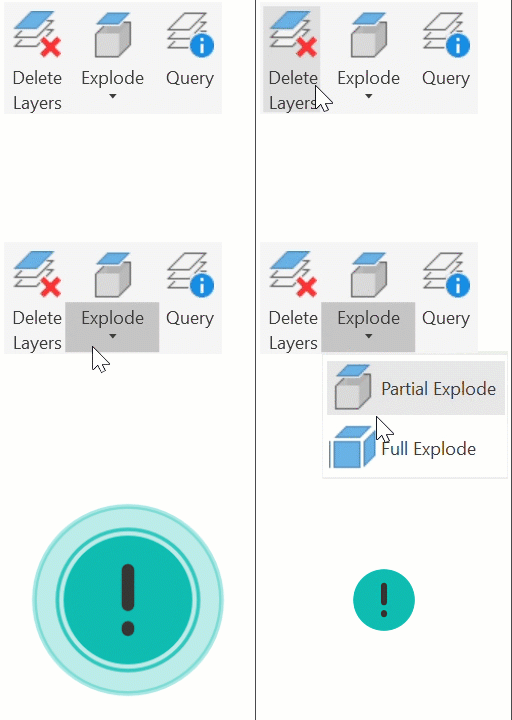
Revit Buddy runs on action-level data collected directly from Revit. Similar usage-triggered alerts can be built across the many other data sources Bimbeats collects.
A Training Program That Runs Itself
Parkhill’s Revit Buddy is a digital tap on the shoulder that acts on a learning opportunity the moment it arises. Once set up, it requires no additional management overhead, no scheduled training sessions, and no after-the-fact audits to catch what it already addressed in the moment.
Users consistently guided in the right direction build better habits. Models stay cleaner. There are fewer coordination issues. Project delivery becomes more predictable. The result, over time, is a firm where best practice is just how people work.
You are already generating the data
The question is what you're building with it
For Parkhill, the true return on investment isn’t just measured in the hundreds of hours reclaimed from automating tasks or the surgical precision of their infrastructure spend. It is measured in the shift from operational oversight to true data governance.
What they built were targeted systems, each solving a specific problem that was costing the firm time, money, or quality. The sophistication isn't just in the technology, It's in the decision to look closely at their data and act on it.
Every firm running Revit, managing projects in ACC, or operating license-capped software, is already generating the data Parkhill used to build these systems.
Innovation isn't just about the tools you use. It comes from understanding how people and technology work together. For firms who want to lead, that data isn't a byproduct of how they work. It's the foundation.
Brought to you by Bimbeats.
Automated real-time data analytics across your software stack.